
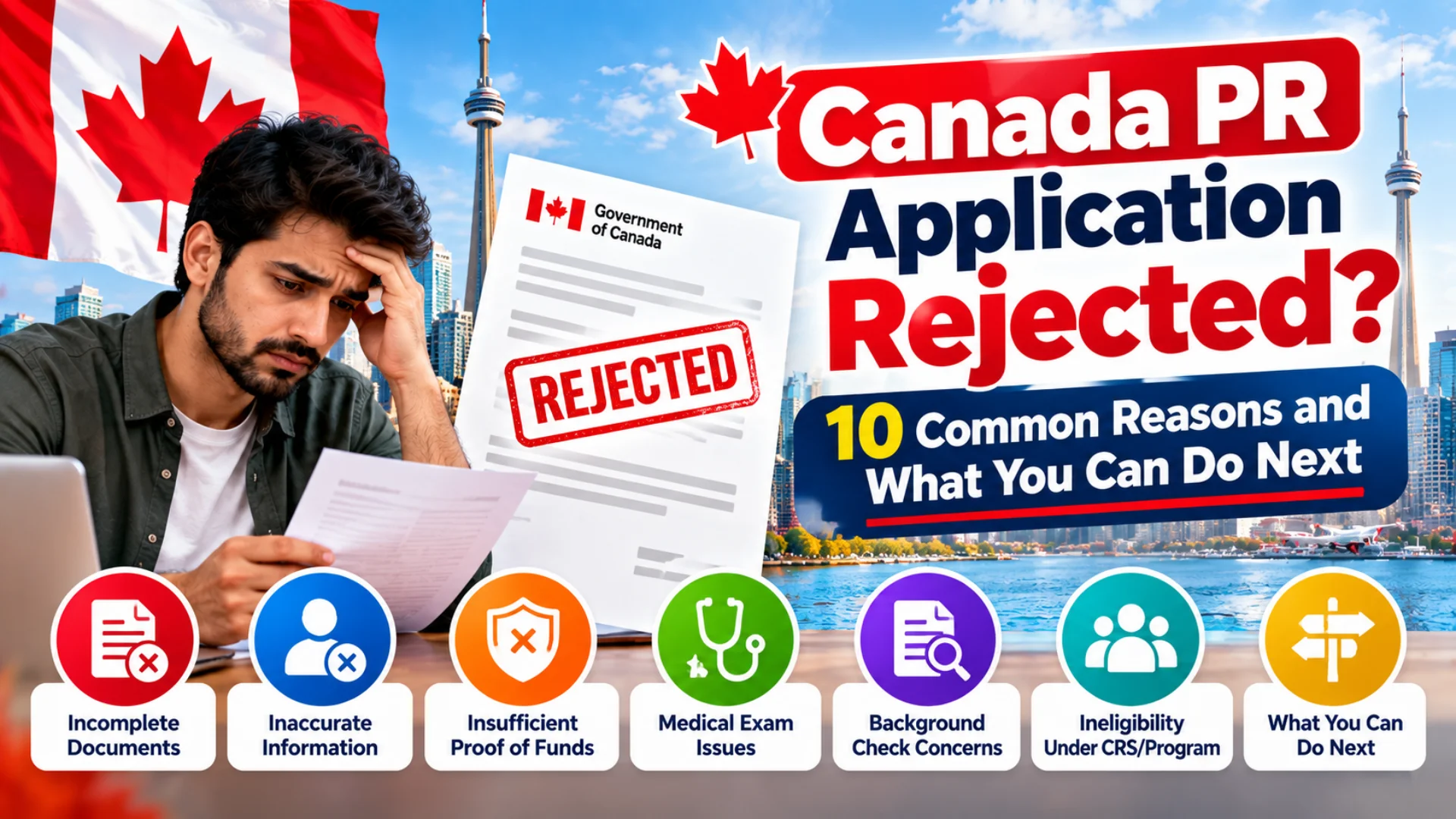
Getting a Canada PR application rejected or refused can be stressful, especially after spending months preparing documents, completing medicals and waiting for a decision.
A refusal does not always mean that you cannot apply for Canada PR again. The important step is to understand why IRCC refused the application and determine what needs to be corrected before taking further action.
For most permanent residence applications, IRCC now provides an officer decision note with the refusal letter, which can help applicants understand the reasons behind the decision. This applies to most PR applications refused on or after May 26, 2026.
10 Common Reasons for Canada PR Refusal
1. Incomplete or Incorrect Documents
Missing documents, unclear documents or information that does not match across forms can create problems with your application.
IRCC checks whether the application is complete, accurate and supported by the required documents.
2. Not Meeting Program Eligibility
You may have received an ITA but still need to meet the eligibility requirements of the specific Express Entry program under which you were invited.
If the officer determines that you do not meet the requirements, the application can be refused.
3. Incorrect Work Experience
Your claimed work experience must meet the requirements of the applicable immigration program.
Problems can arise when employment letters do not properly establish your duties, employment period, hours or other required information.
4. Language Test Problems
Expired or incorrectly reported language test results can affect your eligibility or CRS score.
IRCC requires candidates to keep their Express Entry profile updated when their language test results change or expire.
5. Misrepresentation
Providing false information or leaving out important information can have serious consequences.
IRCC states that misrepresentation can result in refusal, inadmissibility and potentially a 5-year ban from applying to come to Canada.
6. Medical Inadmissibility
Applicants must meet Canada’s medical admissibility requirements.
A medical issue does not automatically mean every applicant will be refused, but certain health circumstances can result in inadmissibility under Canadian immigration rules.
7. Criminal or Security Inadmissibility
Criminality, serious criminality, security concerns and certain other circumstances can make a person inadmissible to Canada.
The specific consequences depend on the circumstances and applicable Canadian immigration law.
8. Proof of Funds Problems
Some Express Entry applicants must demonstrate that they have sufficient settlement funds.
If your financial situation changes and you no longer meet the applicable requirement, this can affect your eligibility.
9. CRS Score Became Too Low
Your circumstances can change between receiving an ITA and submitting your PR application.
For example, a language test may expire, or another factor that contributed to your CRS score may change. IRCC warns that applying when your recalculated score is below the applicable invitation cut-off can result in refusal.
10. Inconsistencies in Your Application
Differences between your Express Entry profile, application forms and supporting documents can raise concerns.
Dates, job history, education, marital status and travel or immigration history should be accurate and consistent.
What Should You Do After a Canada PR Refusal?
Step 1: Read the Refusal Letter Carefully
Start with the official refusal letter. Identify exactly why the application was refused.
Step 2: Review the Officer Decision Notes
For most PR applications, IRCC now provides officer decision notes with refusal letters. These notes can provide additional details about the officer’s reasoning.
Step 3: Identify Whether the Problem Can Be Corrected
For example, if the refusal involved documentation, eligibility or inaccurate information, determine what needs to change before submitting another application.
Step 4: Consider Reapplying
IRCC states that, in general, you can apply again after an immigration refusal unless the decision letter says otherwise. However, you should only reapply when you can address the issue that caused the previous refusal.
For Express Entry, a refused application does not automatically put you back into the pool. To be considered in future invitation rounds, you generally need to create and submit a new Express Entry profile and meet the eligibility requirements again.
Step 5: Get Professional Advice for Complex Cases
If the refusal involves misrepresentation, criminal inadmissibility, medical inadmissibility, complicated work experience or other legal issues, consider getting advice from a qualified Canadian immigration professional before submitting another application.
Final Thoughts
A Canada PR refusal is not something you should simply ignore or immediately reapply after.
First understand the exact reason for the refusal, review the officer’s decision notes, identify what went wrong and then decide whether correcting the problem and submitting a new application is appropriate.
For Express Entry applicants, maintaining accurate information is particularly important because changes to your language results, work experience, family situation or other factors can affect your eligibility and CRS score.
If your Canada PR application has been refused from Saudi Arabia, UAE, Bahrain, Qatar, Kuwait, Oman or another country, a detailed review of the refusal reasons can help you understand what options may be available next.
Frequently Asked Questions
Can I apply for Canada PR again after refusal?
In general, you can apply again unless your refusal letter says otherwise. However, you should address the reason for the previous refusal before submitting another application.
Will a Canada PR refusal affect my future applications?
It depends on the reason for the refusal. A refusal itself is different from a finding of misrepresentation or inadmissibility. Always disclose previous applications and refusals when required.
Can I appeal a Canada PR refusal?
The appropriate legal remedy depends on the type of application and the circumstances of the refusal. In some cases, applicants may consider seeking judicial review. Because deadlines and procedures can apply, legal advice may be appropriate for complex cases.
Will IRCC refund my application fee after refusal?
Generally, processing fees are not refunded once IRCC has started processing the application. Some fees, including the Right of Permanent Residence Fee in applicable cases, may be refundable.
What is the first thing I should do after a PR refusal?
Read the refusal letter and officer decision notes carefully. Identify the exact refusal reason before deciding whether to reapply, correct the application or explore another immigration pathway.